Medical baby cribs are not simply smaller hospital beds. Their safety depends on design, intended use, patient age, and the care environment. So, what are the safety standards for medical baby cribs? The answer usually combines pediatric sleep guidance, crib construction rules, medical-device risk controls, and facility procedures. Requirements may differ between a newborn nursery, neonatal intensive care unit, and home-care setting. That difference matters.
The American Academy of Pediatrics reports that approximately 3,500 sleep-related infant deaths occur annually in the United States. Its safe-sleep policy recommends a firm, flat, non-inclined surface with no loose bedding. Dr. Rachel Moon, a leading safe-sleep researcher, states, “The safest place for a baby to sleep is on a firm, flat surface.” The U.S. Consumer Product Safety Commission also enforces federal crib requirements under 16 CFR Part 1220. ASTM F1169 addresses full-size cribs, while ASTM F2194 covers bassinets and cradles. These standards examine spacing, structural strength, mattress fit, entrapment risks, and hardware performance.
However, compliance is not a magic shield. A crib may pass testing yet fail through poor assembly, worn latches, incorrect mattress thickness, or overlooked cleaning damage. The CDC’s infant-safety guidance and hospital accreditation practices reinforce routine inspection, staff training, and documented maintenance. This 2026 guide compares the major standards, certification expectations, and practical checks that buyers should review. It also examines gaps between laboratory testing and bedside use. Those gaps deserve attention. A label alone cannot protect a restless infant, especially when alarms, tubing, or caregiver access complicate the sleeping space.
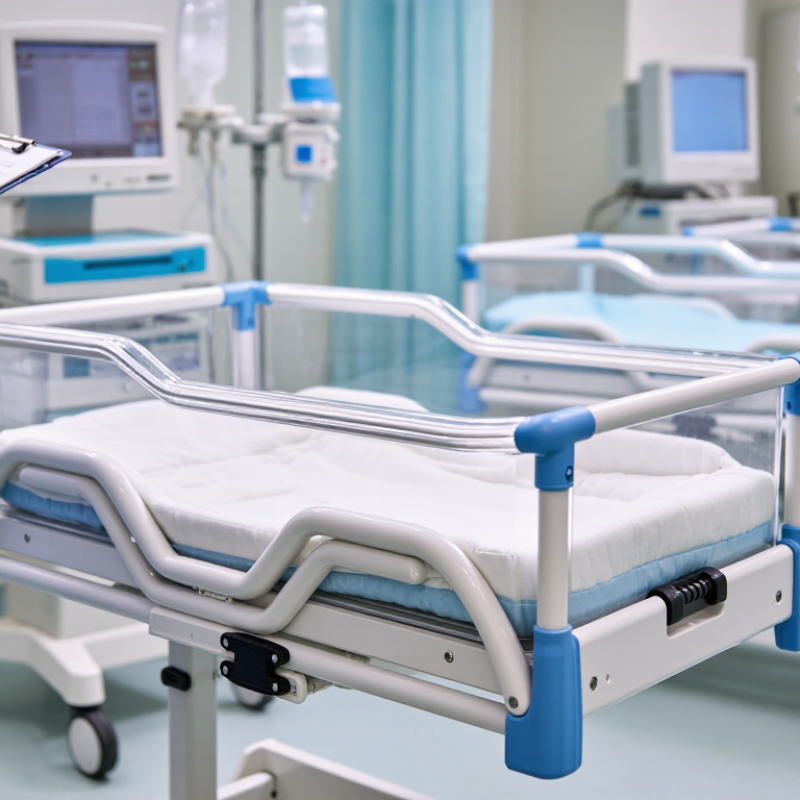
Medical baby cribs serve different clinical purposes, so one design cannot meet every infant’s needs. Open hospital cribs support stable newborns who need observation and routine care. Enclosed incubators help premature infants control body temperature and humidity. Radiant warmers provide quick access during assessment or resuscitation. Transport cribs protect infants during movement between departments. Each type has a different risk profile.
Premature infants face heat loss, fragile skin, breathing instability, and infection exposure. Larger infants may face falls, limb entrapment, or unsafe climbing. Babies connected to oxygen, feeding tubes, or monitors need careful line management. A crib should provide secure rails, stable wheels, smooth surfaces, and clear visibility. It should also support cleaning between patients. Small details matter. A poorly positioned cable can become a serious hazard.
Applicable safety requirements depend on the country, crib classification, and clinical setting. Hospitals commonly review medical-device rules, electrical safety, rail spacing, caster stability, mattress fit, and infection-control procedures. Staff should verify testing records and follow the manufacturer’s clinical instructions. Standards alone cannot replace bedside judgment. A checklist may confirm a locked wheel, yet miss a loose tube beneath the mattress. I would also question whether every alarm remains visible during routine care. Risk assessment should match the infant, equipment, and treatment plan, with regular reassessment as the infant’s condition changes.
| Medical Crib Type | Typical Clinical Use | Common Infant Risk Profile | Key Safety Features to Verify | Relevant Standards or Regulatory References | Typical Suitability |
|---|---|---|---|---|---|
| Full-Size Fixed-Side Hospital Crib | Routine inpatient care for infants who do not require an intensive-care incubator or bassinet. | Moderate: entrapment, falls, mattress gaps, and accidental access by other children. | Securely latching side panels, rigid mattress support, appropriate mattress fit, smooth surfaces, rounded corners, and stable locking casters where fitted. | In the United States, full-size cribs are generally evaluated under 16 CFR Part 1220 and ASTM F1169. Requirements may vary when the product is designed specifically for healthcare use. | Suitable for supervised hospital use when the infant can maintain a safe position and does not need specialized thermal or respiratory support. |
| Full-Size Drop-Side or Access-Side Medical Crib | Clinical care requiring easier access for staff, such as examinations, feeding, or transfer. | High if poorly designed or maintained: side disengagement, entrapment, falls, and pinch points. | Controlled access mechanism, positive locking indicators, protection against unintended release, gap control, and documented inspection of hinges and latches. | Current U.S. crib rules restrict traditional drop-side designs for covered consumer cribs. A healthcare product must be assessed against its applicable medical, institutional, and crib-safety requirements. | Appropriate only where trained staff control access and the side mechanism is included in a formal maintenance and inspection program. |
| Non-Full-Size Medical Crib | Compact rooms, transport areas, specialty units, or care settings where a full-size crib is not practical. | Moderate to high: entrapment, falls, instability, and incorrect mattress dimensions. | Clearly specified internal dimensions, compatible mattress, secure sidewalls, stable base, locking wheels if present, and no accessible openings that can trap the head, neck, or limbs. | In the United States, non-full-size cribs are generally covered by 16 CFR Part 1221 and evaluated using ASTM F406 principles. Other jurisdictions may use different dimensional and performance requirements. | Suitable when the infant’s size, movement, and care plan are compatible with the reduced internal space. |
| Clear-Sided Observation Crib | Continuous visual observation, post-procedure monitoring, or care for infants needing frequent clinical checks. | Moderate: falls, line or tubing entanglement, overheating from added coverings, and caregiver distraction. | Clear panels that remain secure, unobstructed visibility, rounded and sealed edges, accessible emergency release, and compatibility with monitoring cables. | Crib construction should comply with the applicable crib standard and local healthcare-facility requirements. Transparent materials should be durable, cleanable, and resistant to cracking or sharp-edge formation. | Useful for observation, but visibility does not replace direct supervision or continuous monitoring when clinically indicated. |
| Adjustable-Height Medical Crib | Reduces staff bending during assessments, transfers, feeding, or procedures. | Moderate: falls from an elevated position, unintended movement, pinch injuries, and incorrect height selection. | Reliable height locks, protected lift mechanisms, stable casters, brake verification, anti-crush clearances, and controls inaccessible to unsupervised children. | Applicable crib requirements should be combined with facility equipment policies and risk-management procedures. Electrically powered features may also require electrical safety evaluation appropriate to the equipment and jurisdiction. | Best for clinical environments with trained users and documented checks before and after height adjustment. |
| Mobile or Transport Medical Crib | Movement between rooms, diagnostic departments, treatment areas, or recovery spaces. | High during movement: rolling away, collisions, tipping, falls, and disconnection of attached lines or oxygen equipment. | Four-wheel braking or equivalent parking system, controlled steering, secure sidewalls, low center of gravity, push handles, accessory retention, and a clear transport route. | Crib safety rules may apply together with institutional requirements for mobile patient equipment. Transport procedures must address braking, loading, elevators, thresholds, and attached equipment. | Suitable only when operated by trained personnel and when the infant and all attached equipment are secured before movement. |
| Therapy-Compatible Crib | Care for infants receiving phototherapy, oxygen, monitoring, feeding support, or other bedside treatments. | High: treatment interruption, cable or tubing entanglement, oxygen-related hazards, overheating, and restricted access during emergencies. | Designated cable-routing areas, unobstructed emergency access, compatibility with prescribed equipment, adequate ventilation, secure accessory mounts, and no improvised mattress or padding modifications. | The crib itself must meet applicable crib requirements; attached therapy devices are governed by their own applicable medical-device, electrical, electromagnetic, and infection-control requirements. | Use only after confirming compatibility with every attached device and the infant’s clinical care plan. |
| Neonatal Intensive-Care Bed or Incubator | Premature, very-low-birth-weight, unstable, or critically ill newborns requiring thermal control and intensive monitoring. | Very high: hypothermia or hyperthermia, respiratory compromise, infection, skin injury, falls, and disruption of life-support equipment. | Controlled thermal environment, humidity management where indicated, access ports, alarm systems, weighing capability where appropriate, infection-control design, and compatibility with intensive monitoring. | These products are specialized medical devices and are not interchangeable with ordinary hospital cribs. Applicable medical-device regulations and recognized device-specific standards depend on the jurisdiction and product classification. | Not a substitute for a standard crib; requires neonatal-trained staff and continuous clinical assessment. |
| Bassinette or Small Infant Bed | Short-term care for newborns who need proximity to staff but do not require an incubator. | Moderate: falls, suffocation from soft items, entrapment, overheating, and incorrect use beyond the recommended size or developmental stage. | Firm, flat, well-fitting mattress, breathable but secure sidewalls, stable frame, no loose bedding, and clear limits for infant weight, length, and mobility. | Residential bassinets may fall under different requirements from hospital bassinets. In Europe, EN 1130 is commonly associated with domestic-use bassinets; local healthcare and procurement rules may also apply. | Appropriate for smaller or less mobile infants within the manufacturer’s stated limits and under clinical supervision. |
| Special-Needs or Safety Enclosure Crib | Selected cases involving severe movement, seizure risk, behavioral risk, or medical equipment protection. | High and individualized: suffocation, overheating, climbing, restraint-related injury, delayed emergency access, and psychological distress. | Documented clinical justification, rapid-release access, ventilation, visibility, avoidance of entrapment zones, individualized monitoring, and a regularly reviewed care plan. | Should not be treated as a routine sleep product. Restraint, enclosure, and medical-device requirements may apply separately, depending on design and jurisdiction. | Use only after multidisciplinary assessment; the least restrictive safe option should be selected and reviewed frequently. |
| Emergency or Resuscitation-Compatible Crib | Rapid response, stabilization, transfer, or care where immediate access to the infant is essential. | High: delayed access, line dislodgement, falls during emergency handling, and equipment interference. | Fast and intuitive access, secure working surface, space for emergency equipment, strong brakes, clear identification of release points, and unobstructed staff access. | Must meet the applicable crib or medical-device requirements and the healthcare facility’s emergency-equipment policies. Emergency-use design should be validated through staff training and drills. | Best for designated clinical areas with trained personnel and routine emergency-readiness checks. |
| All Medical Crib Types | General infant care in hospitals, clinics, rehabilitation units, and other supervised healthcare settings. | Risk depends on condition: unsafe sleep position, loose items, entrapment, falls, infection transmission, and equipment-related hazards. | Firm flat sleep surface, correctly fitted mattress, no pillows or loose blankets unless clinically required, secure sidewalls, safe clearance from cords, effective cleaning, and documented pre-use inspection. | Standards are jurisdiction-specific. A U.S. purchaser should verify the applicable Consumer Product Safety Commission rules and ASTM standard; international purchasers should confirm the relevant national or regional requirements. | Selection should be based on infant size, mobility, acuity, therapy requirements, staff workflow, infection-control policy, and emergency-access needs. |
| Safety and Maintenance Baseline | Applies before every use, after relocation, and following cleaning, repair, or accessory changes. | Potentially high if omitted: unnoticed damage can create entrapment, fall, infection, or equipment failure hazards. | Inspect latches, sidewalls, mattress fit, wheels and brakes, fasteners, surfaces, labels, accessories, and electrical components where fitted. Remove damaged equipment from service. | Follow the product’s instructions for use, facility policy, preventive-maintenance schedule, incident-reporting process, and all applicable legal requirements. | Essential for every crib type; a standards-compliant design cannot compensate for incorrect assembly, incompatible accessories, or poor maintenance. |
| Important Scope Note | Standards do not by themselves determine whether a crib is clinically appropriate for a particular infant. | Variable: risk changes with age, weight, mobility, diagnosis, therapy, and supervision level. | Use a documented risk assessment, verify the intended user population, and confirm that the crib’s dimensions and accessories match the care plan. | Standards and regulations can change. The current edition, national adoption, product classification, and healthcare-facility policy should be confirmed before purchase or clinical use. | Final selection should be approved by qualified clinical, safety, biomedical, infection-control, and procurement personnel as appropriate. |
An open hospital crib supports stable newborns needing observation and routine care. It allows quick access and clear visibility. Small details still matter.
Enclosed incubators help premature infants control body temperature and humidity. These infants may lose heat quickly. Their fragile skin also needs careful protection.
Radiant warmers provide rapid access during assessment or resuscitation. They support urgent care when every second matters. Heat exposure still requires monitoring.
Premature infants face heat loss, breathing instability, fragile skin, and infection exposure. Their condition can change quickly. Reassess often.
Larger infants may fall, climb, or trap a limb. Secure rails and suitable mattress dimensions reduce these risks. Supervision remains necessary.
Keep oxygen lines, feeding tubes, and cables visible and free from pressure. Check beneath the mattress during routine care. A loose cable can become dangerous.
The mattress should fit tightly on every side. No soft gap should appear under pressure. Use a firm, washable medical mattress without exposed foam.
Test locked wheels on the actual ward floor. Inspect rail latches, fasteners, mattress compression, and caster movement. Laboratory testing may not reveal every weakness.
Confirm locked wheels, secure rails, tight mattress fit, smooth surfaces, and visible alarms. Also inspect hidden tubing. Checklists help, but they can miss real bedside problems.
Medical baby cribs are designed for hospitals, neonatal units, and other clinical settings where infants may require monitoring, treatment, or controlled positioning. Their design should reflect different infant risk profiles, including limited mobility, medical devices, and increased vulnerability to falls, entrapment, and infection. What are the safety standards for medical baby cribs? In the United States, evaluation commonly centers on CPSC 16 CFR Part 1220 and ASTM F1169, with attention to structural strength, side-rail performance, mattress fit, openings, and stability.
International assessment may also consider EN 716, EN 60601-2-52, and ISO 13485, depending on the crib’s intended use and classification. A thorough 2026 evaluation should combine safety testing with hospital design criteria, including secure locking systems, controlled rail movement, durable surfaces, easy cleaning, and compatibility with clinical equipment. Infection-control features and documented manufacturing processes are equally important. Ultimately, the best crib is not merely compliant; it should reduce foreseeable risks, support efficient clinical care, and provide measurable value for infants, caregivers, and healthcare facilities.

 Datoral Medical