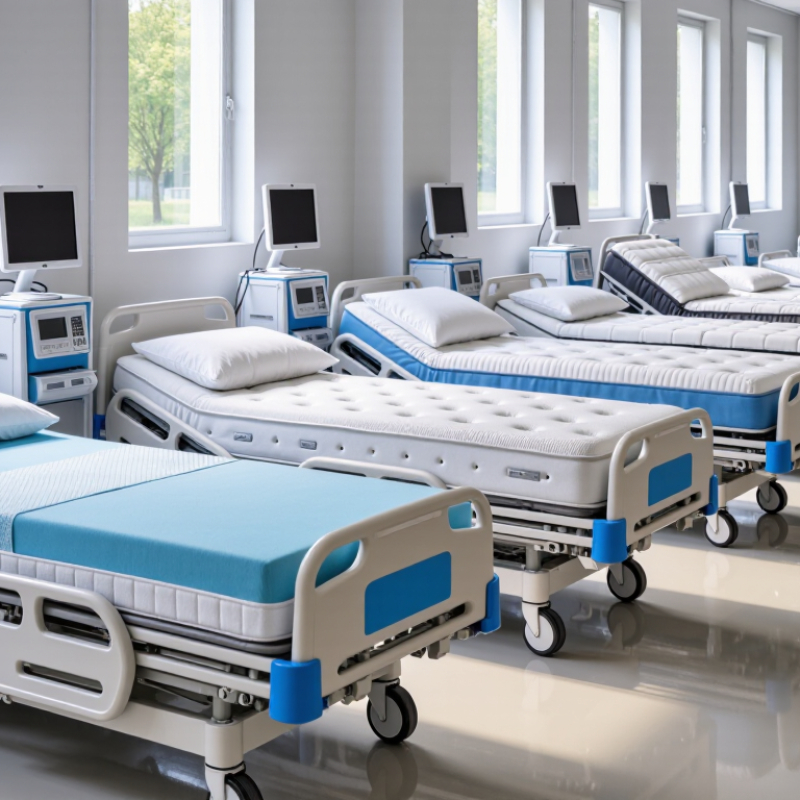
| Standard High-Density Foam Mattress |
Single-layer or multi-layer polyurethane foam with a waterproof, medical-grade cover. |
3–5 years |
General inpatient care, short-term stays, examination areas, and basic home-care beds. |
Patient weight, daily use, compression, cleaning chemicals, moisture exposure, and repeated bed articulation. |
Visible sagging, permanent body impressions, reduced support, torn cover, fluid penetration, or crumbling foam. |
| Pressure Redistribution Foam Mattress |
Multiple foam layers with different densities and support zones designed to distribute body pressure. |
4–7 years |
Patients at moderate risk of pressure injury who do not require an powered air system. |
Patient size, frequency of repositioning, compression set, cover integrity, cleaning procedures, and load concentration. |
Loss of resilience, uneven support, bottoming out, foam deformation, or damage to the protective cover. |
| Gel-Infused or Gel Overlay Mattress |
Foam support combined with gel layers, gel pods, or a gel overlay for pressure redistribution. |
3–5 years |
Pressure redistribution for patients requiring additional comfort and thermal stability. |
Gel migration, temperature changes, heavy loads, sharp objects, cover damage, and improper folding or storage. |
Gel leakage, hardening, pooling, loss of cushioning, exposed components, or an uneven sleeping surface. |
| Static Air Mattress |
Non-powered air cells or air-filled chambers, usually combined with a foam base and protective cover. |
3–5 years |
Pressure redistribution for patients with low to moderate pressure-injury risk. |
Punctures, valve wear, overloading, improper inflation, folding while inflated, and exposure to heat or chemicals. |
Persistent air loss, visible leaks, damaged valves, uneven inflation, or inability to maintain the intended support. |
| Alternating-Pressure Air Mattress |
Powered air cells that inflate and deflate in cycles to periodically change pressure beneath the patient. |
3–7 years |
Patients at high or very high risk of pressure injury when clinically prescribed and properly monitored. |
Pump operating hours, air-cell punctures, electrical components, filter condition, moisture, and maintenance quality. |
Alarm faults, pump failure, irregular cycling, air-cell leaks, noisy operation, or inability to maintain pressure. |
| Low-Air-Loss Mattress System |
Powered air cells or a permeable air-filled surface that delivers a continuous flow of air to help manage moisture. |
3–7 years |
Patients at elevated pressure-injury risk, particularly when moisture and heat management are important. |
Continuous pump use, blocked air channels, fan or filter wear, punctures, fluid contamination, and electrical maintenance. |
Reduced airflow, persistent moisture, pump alarms, uneven pressure, air leakage, or damaged air channels. |
| Low-Air-Loss and Alternating-Pressure Combination Mattress |
Integrated powered air cells providing both continuous airflow and programmed pressure changes. |
3–7 years |
Complex-care and high-risk patients who need both pressure redistribution and microclimate management. |
Pump and control-unit use, air-cell integrity, cleaning fluids, electrical components, patient weight, and service intervals. |
Repeated alarms, failed control settings, insufficient airflow, pressure loss, damaged cells, or unsafe temperature changes. |
| Hybrid Foam-and-Air Mattress |
Foam foundation combined with powered or non-powered air sections for additional pressure redistribution. |
3–6 years |
Acute care, rehabilitation, and home-care settings requiring adaptable support levels. |
Use of the air module, foam compression, pump performance, weight distribution, moisture, and cover cleaning. |
Air-module failure, foam sagging, loss of pressure adjustment, uneven support, or cover deterioration. |
| Bariatric Heavy-Duty Mattress |
Reinforced multi-layer foam, heavy-duty air cells, or a hybrid construction designed for higher weight capacities. |
3–5 years |
Patients whose weight exceeds the capacity of standard hospital mattresses and bed systems. |
Load rating, shear forces during transfers, patient movement, bed-frame compatibility, compression, and moisture exposure. |
Permanent deformation, reduced edge support, structural damage, failure to maintain pressure, or capacity-related safety concerns. |
 Datoral Medical